
Description
Get ‘Em While You Can: British-Built Wharfedale Aston Bookshelf Loudspeakers Designed by Peter Comeau, Play with Full-Scale Sonics, Include Custom Stands, and Limited to 500 Pairs
Looking for a fantastic bookshelf loudspeaker made in Britain, overseen by an award-winning engineer with no time constraints, and limited to just 500 pairs worldwide? While such a speaker might seem like finding a unicorn, it actually exists —though given its strictly controlled production, probably not for long. All the more reason to grab the Wharfedale Aston now.
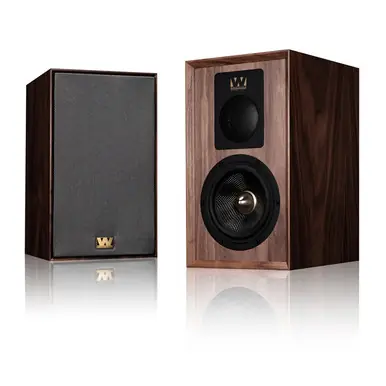
A classic two-way ported standmount featuring brand-new one-inch treble unit and six-inch mid/bass carbon-fiber drivers specifically made for Aston, this Peter Comeau-designed Heritage Series model delivers full-scale sonics that far exceed the modest 13.39 x 7.87 x 10.0-inch (HWD) dimensions. Twin-firing reflex ports help provide clean, extended bass that reaches below 50Hz and a profiled, gold-colored phase plug in the diaphragm center assists with smooth, natural, expressive reproduction of the critical midrange and upper-mid frequencies.
As for that tweeter? It borrows many elements from the one used in the $7,000 Dovedale model, including the combination of a ceramic magnet motor system, fabric dome, and damped rear chamber — an approach that reduces the resonant frequency well below the crossover region. The upshot: The emergence of clear, complete details, tones, and harmonics. Another key element of Aston pertains to the electrical crossover between the drivers. In Aston, air-core inductor coils and high-specification polypropylene capacitors seamlessly mesh the drivers together. The crossover slopes and the shape of the power response were further refined by extensive listening tests with a wide variety of music to ensure the speaker is simply a conduit between your favorite records and your ears.
With a sensitivity of 86dB, Aston is housed in a cabinet comprised of a variety of woods to scatter panel resonances rather than have a single, obvious resonant frequency. An inner layer of high-density particle board bonded to an outer layer of MDF, along with precision-shaped and -positioned internal bracing architecture, further keeps unwanted coloration and vibration to a minimum. Figured-grain, real-wood veneers form the visible exterior and elegantly glow via hand-polished satin lacquer. Removable magnetic grilles that attach to Aston’s recessed baffle, and which incorporate internal shaping to avoid reflections from the cabinet edges, invite you to actually listen with the grilles on and experience the speaker’s heritage profile.
A pair of custom speaker stands —distinguished with a steel open frame along with top and bottom glass inserts —that allow for neat cable management and optimal listening height complete a speaker that is certain to be a now and future classic.
For more information, or to secure your pair of these limited models, dial us up at 312-433-0200.
Designer Peter Comeau Reflects on Aston”When I designed my first commercial pair of hi-fi speakers in the late 1970s, my goal was to make a compact speaker that delivered a wide bandwidth sound – something I felt didn’t satisfactorily exist at the time. In the decades since, I’ve designed speakers of various types and sizes to suit the needs of different customers but, whilst fashions change, small speakers delivering a big performance have remained a cornerstone of every range.””So, when I was offered the opportunity to create a ‘signature’ speaker for Wharfedale’s Heritage Series it was an easy choice to return to this theme, which has been constant in my career since the start. By harnessing the latest developments in cabinet, driver and crossover design from key Heritage Series models, then adapting and enhancing them to suit a two-way speaker with a specifically sized compact cabinet, I’ve created a ‘signature’ speaker that entirely fulfills the brief I set myself for my first commercial design all those decades ago: a compact speaker with a wide-bandwidth sound.””When you hear the Aston, I hope you’ll wonder how we achieved such a full-scale sound from speakers of such diminutive size – natural, even, detailed and engaging across the full frequency spectrum. The answer is simple: acoustic engineering of the highest order.”